
Memoir Excerpts. Table of Contents: see top item in Blog Archive.
Subscribe To


 Posts
All Comments
Posts
All Comments
Sunday, March 17, 2024


Wednesday, October 25, 2023
Moscow Microwaves.
Monday, September 16, 2013 (original post)
(Excerpt from Chapter 11.5 Moscow 1977-1979)
 |
| US Embassy Moscow 1953-2000 (OOB) |
Background Materials
 |
| Ambassador Walter Stoessel |
In the wake of Ambassador Stoessel’s announcement, many in the Embassy community felt betrayed about being kept in the dark for so long, and still more were anxious about the health effects the microwaves might be having. Some reportedly filed lawsuits against the Department.
The Purpose of Moscow Signal.
The true purpose of Moscow Signal remains a matter of dispute. One theory was that the microwaves were being used by the Soviets to activate listening devices they had emplaced in the building prior to American occupancy. In fact, conventional wired bugs had been installed as "original equipment" before we moved into the Chancery back in 1953, and the microwaves were thought by some to be an additional espionage tool, in keeping with the "belt and suspenders" strategy often employed by the Soviets (if one way of spying is discovered, others will remain undiscovered).
The Moscow Signal bug theory was described in detail in “The Spy in Moscow Station,” by Eric Haseltine, which recounted the efforts of NSA officer Charles Gandy to get to the bottom of the microwave issue in the late 1970s. His conclusions, which, it should be noted, are still highly controversial, were based on a technical survey done at Embassy Moscow in 1978. Gandy believed that the Soviets were using microwaves (Moscow Unidentified Technical Signals, or MUTS) to activate passive bugs in the walls of the Embassy that were much more advanced than the “Thing,” or Theremin device that was found in Spaso House in 1952 (the signal was first detected in 1951).
 |
| Spaso Great Seal Bug |
Gandy also believed that MUTS was being used to read voices off windows by “RF imposition,” and could be used to intercept electronic signals and voices reflected off electronic devices in unprotected areas by a technique known as “RF flooding.” A few years later, Gandy also took part in efforts leading to the discovery in 1984 of bugged IBM Selectric typewriters in Moscow and Leningrad (Project GUNMAN).
There were other theories as well. Many believed that the microwaves were a jamming signal designed to foil our own electronic devices. However, as the Soviets themselves were the source of this explanation, the theory lacked a certain credibility. It could be that both theories were in fact correct, as they were not necessarily mutually exclusive, but the answer to that question is currently not available in the unclassified realm. To this day, most CIA and NSA records on Moscow Microwaves remain classified.
Possible Health Effects.
That said, many Embassy staffers were less concerned with the ostensible purpose of the microwaves than with what their health effects might be. This apprehension seemed to be borne out over the years by the finding, in the early 1970s, that an unusual number of people were departing post with elevated white cell counts. It also came out that, anecdotally at least, there seemed to be a larger number of cancer cases, and especially leukemia, among former Embassy staff than would appear to be normal.The clincher for many
To most

 |
| Unidentified Staffer in Dushanbe -- 1978 |
Shortly after I returned to the States, I found out that my cavalier attitude toward the microwave issue was not justified. Med informed me in late 1979 that my own white cell count was much higher than normal, and advised me to continue testing. In 1985, my white cell count got high enough for Med to recommend that I see a hematologist, so I went to a local doctor in
As the reality of my illness began to set in, I started studying the issue. My research on CLL was not encouraging. Most patients progressed slowly to Stage Four and survived on average only a few years. The mortality rate 20 years out was close to 100 percent. I determined to fight the disease as best I could by leading a healthy lifestyle, although, paradoxically, I then volunteered for a high-risk assignment to
My white count stayed stable through the 1980s, although I did notice that there were periods where I would look especially pale or have slightly swollen glands. My visits to Dr. Fong convinced me, however, that I was doing much better than expected. Most other patients I saw were very sick indeed, a pitiable lot. In the 1990s for reasons no one can really explain, my white count began to normalize. By 1999, my CLL was in remission. At my last State Department physical in 2001, my “1” clearance was restored. In more recent times, my CLL has appeared again, but still at a level that does not require chemotherapy.
In a 2018 biography of Ambassador Tommy Thompson, “The Kremlinologist,” daughters Jenny and Sherry Thompson wrote about microwaves beamed at the U.S. Embassy when their father was Ambassador to Moscow 1957-62. According to them, the Soviets also bombarded Spaso House, the Ambassador’s residence, with microwaves. In fact, a security team advancing Vice President Nixon's visit in 1959 noted a spike in radiation levels just before his arrival. After a protest, the radiation level dropped, but no one apparently bothered to follow up to see whether the radiation returned to its former high level after that. “No one seemed to care…if the radiation continued or not after Nixon left.” (see p. 181). The daughters also noted parenthetically that the U.S. was doing something similar to "listen to the Soviet Embassy in Washington, DC," without giving a source for their information.
 |
| Spaso House |
A similar story was told in "K Blows Top" (pp. 31-33, pub. 2009) by Peter Carlson, a humorous history of Khrushchev's rather strange trip to the US in 1959, and Nixon's trip to Moscow that took place a few months earlier. In fact, the story parallels very closely the account in recently declassified documents , which revealed that Spaso residents were being bombarded not by microwaves, but ionizing radiation, and reported how Secret Service agents managed to stop the threat, at least for the duration of Nixon's visit. That Carlson was able to pick up this story and retell it in a humorous fashion indicates that it was generally known in the Washington national security community. The story was also told, briefly, in Khrushchev's Cold War, by Aleksandr Fursenko and Timothy Naftali (p. 249 and note 49, pub. 2006).
II. Phenomena: Moscow Microwaves in the 1960s and 1970s.
Information on Moscow Signal is sketchy in the public domain, but a recent book, “Phenomena,” published in 2017, by Annie Jacobson, adds in some new information on how the Moscow Signal issue was handled – or mishandled -- in the 1960s and 1970s.
Following the discovery that microwaves were being beamed at the US Embassy in Moscow, “scientists with Johns Hopkins University’s Applied Physics Laboratory were assigned to oversee research into the phenomenon. An elaborate facility was constructed inside the Walter Reed Army Institute of Research, Forest Glen Section. Here, inside an anechoic chamber (an echo chamber designed to completely absorb reflections of either sound or electromagnetic waves), primates were irradiated with microwave beams with a power density similar to that of the Moscow Signal. ARPA’s Richard S. Cesaro was in charge of what was called Project Pandora. Within a few months of beaming the signal at the monkeys, Cesaro became convinced of its harmful nature, deciding that it adversely affected the internal organs of primates, including the brain. “In our experiments, we did some remarkable things. And there was no question in my mind that you can get into the brain with microwaves,” Cesaro later said. It was later determined that the microwave beam produced Alzheimer’s disease.” [It should be noted, however, that Cesaro’s findings were highly disputed, as were all findings that the microwaves caused harm to humans. Cesaro himself was fired from ARPA in 1969.]
During the 1960s, secret studies were carried out on Embassy Moscow personnel, who were not told about the microwaves, but were given the cover story that “viral studies” were being conducted.
 |
| U.S. Embassy Moscow, 1964 (Bettman Archive) |
There was much controversy about whether microwaves were harmful. Dr. Samuel Koslov, a Navy scientist who worked on the ARPA project, contended the signals were harmless. Many others did not agree, but Koslov’s view eventually prevailed.
A few government scientists broke ranks and discussed the government’s shortcomings in the area of electromagnetic weapons. They included the biologist Dr. Allan H. Frey, who made a number of important contributions to the study of microwaves, including the discovery of the “Frey effect,” or the ability of subjects to hear microwaves at certain frequencies and interpret the sound as clicks.
A colleague, Dr. Robert O. Becker, resigned from his position because he thought the research the US government was conducting was immoral. At this time, the government was still keeping Moscow Signal secret from Embassy Moscow employees, and reportedly had used microwaves to experiment secretly on U.S. Navy personnel at the Philadelphia Navy Yard. “Becker’s government work convinced him that a microwave signal such as the Moscow Signal ‘could affect the central nervous system, put people to sleep, interfere with decision-making capacity and induce chronic stress,’ he said, and noted that the Soviets had been ‘using embassy employees as test subjects for low-level EMR [electromagnetic radiation] experiments.’
“The government had succeeded in keeping the programs secret, from the discovery of the Moscow Signal in 1962* until February 1976, when the Los Angeles Times broke the story. The unraveling had begun in 1973 when a new and more powerful set of Soviet microwave beams were picked up by the CIA in Moscow. Like the original Moscow Signal, these new electromagnetic beams were aimed at the upper floors of the embassy, where the ambassador and top intelligence officials had their offices.
“Finally, fourteen years after its discovery, in January 1976, U.S. Ambassador Walter Stoessel was briefed on the Moscow Signal. Stoessel filed a formal protest with the Soviets and…informed embassy personnel about their exposure to high-powered microwave beam radiation. ‘Several members of the embassy staff display symptoms that are non-specific but have been reported frequently in patients chronically exposed to non-ionizing radiation,” a State Department doctor reported. Symptoms included severe headaches, inability to concentrate, and fatigue.
“One hundred U.S. Embassy employees previously stationed in Moscow filed $250 million worth of lawsuits against the government for exposure related to Moscow Signal. In response, the State Department funded a [$300,000] study by the Johns Hopkins University School of Hygiene and Public Health, the same institution that had created the synthetic Moscow Signal against the monkeys. The study, released in November 1978, found ‘no convincing evidence that any employees suffered ‘adverse health effects as of the time of this analysis.’ According to State Department medical consultant Dr. Herbert Pollack, who advocated on behalf of the victims in a Senate subcommittee investigation, every suit was eventually withdrawn, ‘without a penny being paid.’
---------------------------------------------------------------------------------------------------------
*Note: Just as it took seven years for the US to discover that radio waves were activating a bug in Spaso House (1945-52), it is likely that the Soviets were using microwaves on Embassy Moscow long before they were first noted in 1962. This is why, for example, the 1978 Johns Hopkins study surveyed Embassy personnel going all the way back to the opening of the OOB at Tchaikovsky 19 in 1953.
It also raises the question, which will probably never be answered, of
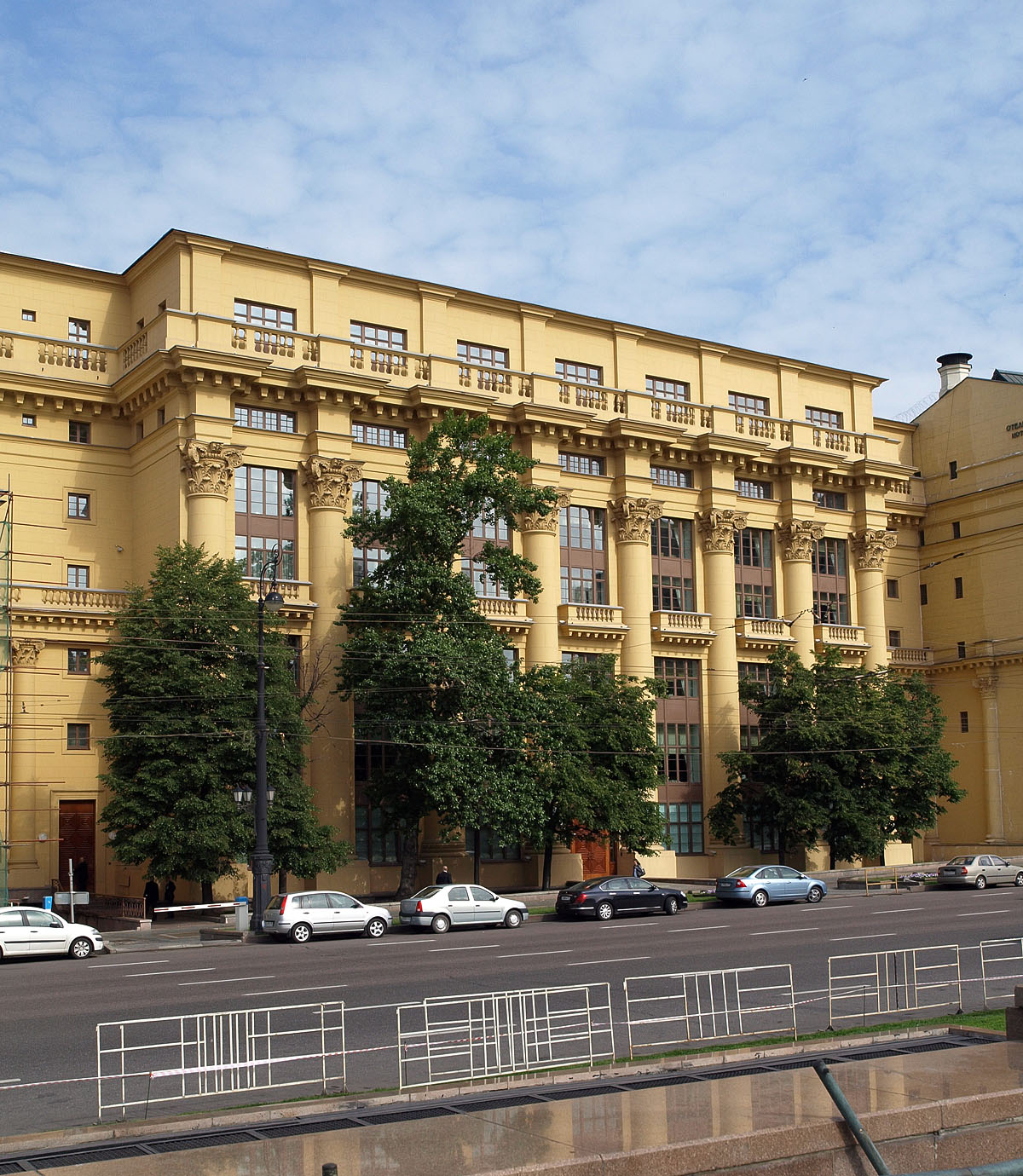 |
| 13 Mokhovaya |
Based on this report, which was done in 2019, there are strong indications that the 1978 Johns Hopkins study was rushed out in order to counter the $250 million dollars in lawsuits that were pending, and may have been toned down by the State Department to avoid liability. It was not peer reviewed at the time.
Some major conclusions of the 2019 re-evaluation:
1. "In 2011, the International Agency for Research on Cancer (IARC) categorized radiofrequency electromagnetic fields as a possible carcinogen (Group 2B), and the debate over the safety of microwaves has raged ever since. The recent findings on animal experiments published by the National Program of Toxicology (2, 3) and the Ramazzini Institute (4) seem to indicate that a re-evaluation is needed, and that radiofrequency electromagnetic fields should be reclassified as being probably carcinogenic to humans (Group 2A), or even as being carcinogenic to humans (Group 1),"
2. Havana Syndrome is strongly suspected to be the result of a microwave attack. Because of the similarity in symptoms to those experienced by victims of Moscow Signal: "The “Moscow signal” case, therefore, needs to be seriously reconsidered."
3. "The researcher J. R. Goldsmith harshly criticized the results of the study of Lilienfeld et al. [the Johns Hopkins study] (1), claiming that the findings had been massaged by the US Department of State, and that the results had been toned down (32). Goldsmith criticized the methodology of comparing the staff of the [Moscow] embassy with that of the other embassies. Why use the other embassies as a control group? How could they be sure that these other embassies had not also been irradiated? As indicated by Carpenter (22), Goldsmith reinterpreted the data from the original study by grouping the cases of deaths among all the embassies and comparing them with the reference population. By presenting the data in this way, the results change ostensibly. Goldsmith linked the cases of workers’ deaths to those of their relatives (“dependents”), which resulted in mortality due to leukemia becoming significant in Moscow. He then added these results to those of the other embassies (“both groups”) and found a statistically higher-than-expected number of cases of leukemia, brain tumors and breast cancer."

4. "According to EMFacts (33), an initial study carried out in Moscow in 1967 on a group of 43 workers (37 exposed and seven unexposed), found abnormalities in the chromosomes of 20 of the 37 who had been exposed to microwaves, compared to two of the seven who had not. Subsequently, in 1976, another hematological study found significant differences between the embassy workers in Moscow and other employees of the foreign affairs service. Larger numbers of white blood cells were reported among the Moscow staff, but these results were never published."
5. "In 1977, in an article published in the Los Angeles Times (37), it was reported that an “authority” had told President Carter that the first residents of the embassy had the highest incidence of cancer of any group of people in the world." [Note: According to Paul Brodeur, Zbigniew Brzezinski told him the same thing in March, 1976. "The Zapping of America," p. 129].
6. Also, in 1977, Stevens (38) published that a third of the diplomats and their families had shown abnormally high levels of lymphocyte counts in recent months. Although at first this was linked to microwaves, the medical authorities soon abandoned this theory, claiming that it was temporary and not a cause for alarm, and that this was not indicative of the development of leukemia. These levels of lymphocytes returned to normal 2 weeks after the individuals left Moscow. The cause of this abnormal level of lymphocytes was blamed on a possible parasite in the drinking water, or on a respiratory infection. However, as Stevens indicated in his article, there was no evidence that the Soviet citizens of Moscow had such high anomalies in the incidence rate as those that existed in the embassy. Stoessel’s death from leukemia a few years later cast doubt on the official American version."
7. "It is unclear why workers and relatives were chosen as study subjects when some of these relatives, including wives and children, obviously received much less exposure to the microwave bombardment."
8. "The authors admit that some medical records were never found, as the investigation was stopped prematurely due to the urgent need to publish the results. Recall that the investigators involved were under pressure to finish the report by a given deadline, and this led to relevant information not being included."
IV. 1996 Incident in "a Hostile Country."
NPR published an article on October 21, 2021 that may be the first detailed reporting on a possible crossover link between Moscow Signal and Havana Syndrome. Titled "Long before Havana Syndrome, the U.S. reported microwaves beamed at an embassy," the story led with details of a 1996 attack on NSA personnel on TDY in "a hostile country."
 |
| Hypothetical Embassy in "a hostile country" |

"In 1996, Michael Beck and a colleague at the National Security Agency were sent to a 'hostile country' on a brief assignment. After being detained at the airport for about an hour, they were allowed to go, but they knew they were being closely watched. A few days into the assignment, Beck woke up at his hotel feeling terrible. 'It was extreme fatigue and weakness. I was a bowl of jelly and couldn't get moving,' said Beck. He was suspicious of the cause, but the symptoms went away. A full decade later, Beck was diagnosed with early-onset Parkinson's disease at age 46. At almost exactly the same time, his colleague from that trip, Chuck Gubete, received the very same diagnosis. Gubete, who died several years later, had a family history of Parkinson's, but Beck didn't. Beck came to believe that his illness was caused while on that trip, and he filed a workers' compensation claim with the NSA. As part of the process, the NSA sent Beck a short but striking letter in 2014: 'The National Security Agency confirms there is intelligence information from 2012 associating the hostile country to which Mr. Beck traveled in the late 1990s with a high powered microwave system weapon that may have the ability to weaken, intimidate or kill an enemy over time and without leaving evidence,' the letter said. 'This weapon is designed to target the living quarters in microwaves, causing numerous physical effects, including a damaged nervous system,' the letter added. The letter also said that it had no evidence that such a weapon "if it existed" had or had not been used against Mr. Beck.

Beck, now living in Maryland, is still battling to prove his claim. The country he traveled to remains classified. But his attorney Mark Zaid notes that the NSA letter was written in 2014 — two years before the first Havana Syndrome cases were reported. 'Here we have an unclassified document from a U.S. intelligence agency admitting it knows of this before Havana,' Zaid said." [Note: Perhaps not coincidentally, an article appeared in Rossiyskaya Gazeta on April 12, 2012 on the same subject].
The identity of the “hostile country” is still classified, but Beck told CBS News in 2019 that the incident in 1996 that made him and his colleague sick occurred in neither Cuba nor China, thus narrowing the field of potential suspects quite a bit – most likely, to one: Russia.
See also blog bibliography item 8A: "Havana Syndrome: NSA Officer's Case Hints at Microwave Attacks since 90s."
Postscript: On June 28, 2023, Courthouse News reported that NSA had prevailed against Beck in a lawsuit to release classified information on his case. The court appears to have disregarded NSA's 2014 admission that the "hostile country" had a microwave weapon that might affect a person's health. The decision seems to give weight only to the fact that there is no evidence the "hostile country" used such a weapon on Mr. Beck and not to NSA's original admission that the "hostile country" did indeed have such a weapon. I'll be interested to see the legal fallout from this.
I have a feeling this case is not over. See Blog bibliography item 72:
https://www.courthousenews.com/nsa-prevails-on-ray-gun-foia/
------------------------------------------------------------------------------------------------
V. Blog Bibliography: Havana Syndrome/ Moscow Microwaves.
A select bibliography of articles and interviews in roughly chronological order.
0. The 1978 Johns Hopkins Moscow Microwave Report
1. Wikipedia on the latest unclassified information on Moscow Signal. Also, the latest information on Directed Energy Weapons.
1A. Wikipedia on the latest unclassified information on Havana Syndrome.
2. Rossiyskaya Gazeta article of April 12, 2012 brags about how in the Soviet era "The USSR leapfrogged ahead of the United States in creating weapons that actually use "new physical principles," namely beams and rays directed by generators that are designed to affect the psychological state of individual targets. It is noted that many who used these generators died of cancer.
2A. Directed Energy Weapon Systems Acquisition Act of 2016.
2B. A Just Security article from August 21, 2017, by John Sipher, entitled "Sonic 'Attacks' on US Diplomats in Cuba: Don't Rush to Conclusions."
3. A Diplopundit article from August 29, 2017, entitled "Microwaving U.S. Embassy Moscow: Oral History from FSOs James Schumaker and William A. Brown."
3A. An article published in the December 2017 issue of URSI Radio Science Bulletin by James C. Lin, entitled, "The Moscow Embassy Microwave Signal." Alternate link
3B. An April 25, 2018 article in "The War Zone" entitled, "The Pentagon Wants to Stop Marauding Vehicles with High-Powered Microwave Beams." "At its most basic, the concept is fairly simple. An array of microwave emitters shoots out a beam of energy that jams electronic devices, such as the control unit in an engine, effectively shutting it down...The force application type is small enough to fit on the back of a truck and could be used to stop a fleeing vehicle or to defend convoys on the move. This could also be useful for law enforcement personnel attempting to stop a specific suspect vehicle or a small smuggling boat. JNLWD says the present prototype of this system has an effective range of approximately 160 feet, according to Defense One." Comment: But I'm sure no one has ever thought of putting a system like this in a white van and using it on people. 🙄
4. A New Yorker article on Havana Syndrome by Adam Entous entitled “The Mystery of Havana Syndrome,” from November 19, 2018. Very comprehensive for the time.
5. Armeyskiy Sbornik article of January 1, 2019 claims that RF/MW weapons "have significantly decreased in size and can be installed on a tank turret and even at the head of a tactical missile ... The [target] begins to hear non-existent noises and whistles ... When exposed to low-frequency electromagnetic radiation, the human brain releases chemicals that regulate its behavior. [The RF/MW devices] can cause symptoms of various diseases..." [Note: As of 2023, the Russian MoD has blocked access to the article. Luckily, however, I found this in San Clemente's unofficial national security library.]

6. A JAMA Study entitled "Neuroimaging Findings in US Government Personnel With Possible Exposure to Directional Phenomena in Havana, Cuba," from July 23/30, 2019.
13. An August 11, 2021 Article published by Polygraph.info, an organization owned by Voice of America, discusses Russian efforts to develop microwave weapons, as well as Russian disinformation efforts to deflect attention from this subject. "Russia’s President Vladimir Putin, defense ministry, top military developers and experts all have hinted at or boasted about electromagnetic weapons."
13A. A September 21, 2021 BBC report entitled "CIA Officer Suffered from Havana Syndrome during India Trip."
14. A September 22, 2021 NBC News story reporting that Pamela Spratlen the "Diplomat overseeing 'Havana Syndrome' response is out after six months." Ambassador Spratlen was widely reported to be unsympathetic to Havana Syndrome sufferers and refused to rule out the "mass hysteria" explanation of the symptoms.
15. A September 30, 2021 Buzzfeed story on the 2018 JASON Report, which looked into the theory that cricket sounds were related to Havana Syndrome, most likely by causing psychogenic illness. Long since discredited. The psychogenic illness theory is still, however, prominently featured as a Cuban and Russian disinformation line.
16. An October 13, 2021 Andrea Mitchell interview of three victims of Havana Syndrome. Many of their symptoms are similar to those noted when victims of Moscow Signal were being studied, indicating microwaves as a possible cause in both cases.
17. An October 29, 2021 scientific study of how the thermal effects of microwaves can cause traumatic brain injury (TBI).
18. A November 5, 2021 NBC News story entitled "State Department Names New Chief of Task Force Overseeing Havana Syndrome Response."
18a. The November 7, 2021 JASON report on Havana Syndrome. Basically denies the reality of Havana Syndrome, says cannot conclude that personnel are being subjected to high-energy attacks, and that only a small number of cases cannot be explained by other factors. In other words, circular reasoning: since there is insufficient evidence to prove for sure that personnel are being attacked, no personnel are being attacked. See items 15, 66.
"Regarding adversarial intent, it is not possible to conclude at this time that the events reviewed by JASON are the result of intentional attacks that cause physical harm. However, it is not possible either, to rule out mechanisms that do not cause any physical harm but which might constitute harassment and lead to health conditions and functional disorders, for example through unpleasant sounds or pressure sensations. Given this, and in the interest of protecting embassy personnel and their families, it would be prudent to be vigilant against tactics intended to produce anxiety and trauma, with an intent to either disrupt operations and/or cause long-term harm The US government could minimize the effects of such tactics, if present, through open communication, education, and appropriate rapid medical response to any conditions that develop."
19. Peter Kornbluh's Nation article on Havana Syndrome from November 13, 2021.
20. A One-hour November 17, 2021 interview with Dr. David Relman, the lead scientist on the NAS report; a number of useful observations.
21. The Accountability Review Board report on Havana Syndrome, originally released in June 2018, is declassified and released on November 19, 2021. The ARB report "faults both the Department of State and the CIA in their responses to early cases of the Havana Syndrome at the U.S. Embassy in Cuba. The report is also the first official confirmation that the CIA closed down its Havana station and pulled its operatives out of Cuba in September 2017. In the report, the ARB criticized the CIA for failing to share information about the health-related experiences of its agents in Havana in late 2016 and early 2017, delaying the State Department’s ability to react quickly.
"...the ARB faulted the failure of an organized response to the emerging crisis on multiple fronts, not just excessive CIA secrecy. The report found that “The Department of State’s response to these incidents was characterized by a lack of senior leadership, ineffective communications, and systemic disorganization.” Most notably, “The Board finds the lack of a designated official at the Under Secretary level to manage the response to be the single most significant deficiency in the Department’s response. To this day [June 2018] no senior official at the Department has been assigned responsibility for leading and coordinating efforts to assess past incidents and prevent/mitigate future events. No Department of State task force was formed.” The ARB also concluded that Secretary Tillerson’s dramatic decision in late September 2017 to reduce the Havana Embassy staff by more than 60 percent and effectively shutter the U.S. Consulate appeared to have violated normal operating practice."
Here is the National Security Archive release of the Accountability Review Board report.
22. Washington Post article, November 24, 2021. CIA Director Burns warns Russians over Havana Syndrome during Moscow visit Nov. 2, 2021.
23. An NYT article on developments as of December 2, 2021.
25. An NBC News documentary on Havana Syndrome with a short segment on Moscow Signal at 14:40--16:10 with me. Went live at 0400 PST on December 22, 2021.
 |
| Jim and Tanya Schumaker, 2012 |
26. Foreign Service Journal, January/February 2022 issue. "Before Havana Syndrome, There Was Moscow Signal." by James Schumaker (alternate link: https://afsa.org/havana-syndrome-there-was-moscow-signal )
27. A New York Times article entitled "Most ‘Havana Syndrome’ Cases Unlikely Caused by Foreign Power, C.I.A. Says," from January 20, 2022 reports that an interim CIA report on Havana Syndrome throws cold water on the idea that some foreign power is behind Havana Syndrome, and now limits the number of unexplained cases to a couple of dozen, not 200 or so, as previously thought. The assertions in this article were walked back by the interagency redacted report (note 30) and CIA Director Bill Burns' interview with CBS Sixty Minutes (note 33).
28. Diplopundit archives on Havana Syndrome, January 19, 2022. [Broken Link as of 26 Oct 2023]
29. A Politico article entitled "Directed-energy could explain unsolved ‘Havana Syndrome’ cases, U.S. intelligence panel finds," from February 2, 2022, in which the Intelligence Community walks back initial press stories on the CIA interim report, and notes that some core cases can be explained by electromagnetic or ultrasonic energy, but not addressing the question of whether there is a perpetrator.
30. The redacted executive summary of the IC Experts Panel on Anomalous Health Incidents (AHIs), from February 1, 2022. Despite the blacked-out text, much is revealed.
31. A Washington Post article entitled "External energy source may explain ‘Havana syndrome,’ panel finds, renewing questions about possible foreign attack," from February 1, 2022, says some cases can be explained by directed energy, but notes that the question of whether a state actor is at work has not been addressed by the IC.
31A. A Guardian article dated February 2, 2022 entitled “Havana Syndrome could be caused by pulsed energy devices – US expert report.”
32. A WhoWhatWhy article entitled "Havana Syndrome is likely real, Feds admit," from February 7, 2022, by famed science investigative reporter Paul Brodeur discussing the similarities between Havana Syndrome and Moscow Signal. Brodeur is 90 years old, but doesn't seem to have lost a step.
33. A CBS Sixty Minutes program entitled "Targeting Americans" from February 20, 2022, reports on Havana Syndrome cases on White House grounds and elsewhere in the United States. Members of VP Pence and Bolton staff were affected. A white van was identified in the vicinity of one attack. Other attacks were described as well: diplomatic staffers in China, Vietnam, India, Vienna and Havana. One family, being treated for Havana Syndrome in Philadelphia experienced attacks in multiple locations. Most likely cause: pulsed microwaves (pictures of portable Russian microwave transmitters shown). Interviews with CIA Director Bill Burns, Dr. David Relman, and James Benford. Burns walked back the premature conclusions of a CIA report which said it was unlikely that a foreign power was behind the attacks. A coordinated interagency report concluded on February 1, 2022 that directed energy attacks were a plausible cause and -- in the redacted version at least -- did not rule foreign actors in or out. The CBS Sixty Minutes program was repeated on June 26, 2022, with some updates. You need to be a Paramount+ subscriber to view it.
33a. An article from March 7, 2022 in Brain Communications, entitled Symptoms reported by Canadians posted in Havana are linked with reduced white matter fibre density. "A study of 16 adult Canadians who reported health incidents in Havana found changes in areas of their brains that were similar to those found in the Americans affected. The study was requested by Global Affairs Canada, the agency that oversees diplomatic relations." [source: item 66]
34. Foreign Service Journal, March 2022 issue. Regarding Moscow Signal, by Jon LeChevet. Retired Embassy Moscow Technical Security Officer argues that Moscow Signal could not have had adverse health effects.
35. A Washington Post article entitled "U.S. to give some 'Havana syndrome' victims six-figure compensation" from June 23, 2022.
36. An RFE/RL video from June 23, 2022 showing a Ukrainian rifle that uses radio waves to disable Russian drones.
37. An interesting Zeit article on Havana Syndrome, dated June 30, 2022. It covers two cases in detail -- those of Robyn Garfield, a Commerce Dept official stationed in Shanghai, and an anonymous CIA employee interviewed under the pseudonym "Adam," also known as "Patient Zero," who was stationed in Havana (these two were also interviewed by CBS Sixty Minutes.
Zeit also details the initial and wholly inadequate State Department response under Secretary of State Rex Tillerson. "When diplomats and agents are injured or even die in the line of duty, the State Department is required by law to launch an investigation within 60 days. But an investigation into the Cuba cases was only opened more than a year later, and then only under pressure from Congress. The results of that inquiry, however, were withheld from Congress, aside from a meager summary. Finally, a Freedom of Information Act suit filed on behalf of a Cuba victim in 2021 – almost three years later –yielded a heavily redacted version of the report [note: a fully declassified version was released on November 19, 2021]. The results can be summarized as follows: The State Department showed no leadership, was disorganized and communicated ineffectively. "No government official ever had responsibility for the problem," the report reads. Furthermore, excessive secrecy prevented the necessary exchange of information between the CIA and the Department of Defense, the report found. All of which meant that the United States State Department proved unable to react appropriately to the threat – a staggering verdict. [Later,] Secretary of State Mike Pompeo rejected an investigation of the cases in China. Even today, such an inquiry has yet to take place." [comment: sounds suspiciously like what happened in the case of Moscow Signal].The Biden administration has performed far better, but much remains to be done. There is still a lot of interagency confusion. Zeit notes correctly, however, that pulsed microwaves are still viewed as the most plausible cause of Havana Syndrome, and that the interagency report from earlier this year recognizes that fact. Zeit also reports that efforts by scientists to publish on pulsed microwaves are being stopped by the Department of Defense (presumably because they are doing such research themselves).
Meanwhile, the question of who may be behind Havana Syndrome is just as murky as ever. "According to a report in the New Yorker , the theory the government is currently operating under is that Russian intelligence agents are seeking to use the microwaves to copy data from the victims’ mobile phones or computers and that the physical symptoms are unintentional side effects. The State Department declined to confirm this theory when contacted, but did not exclude the possibility of "foreign actors."
Zeit also passes along reports that CIA and State are having trouble recruiting new officers as a result of concerns about Havana Syndrome, a contention State denies, saying that it has no trouble hiring. State, as usual, is intentionally missing the point. Applications for the Foreign Service are way down for a variety of reasons, so the pool of applicants to choose from is much smaller than before.
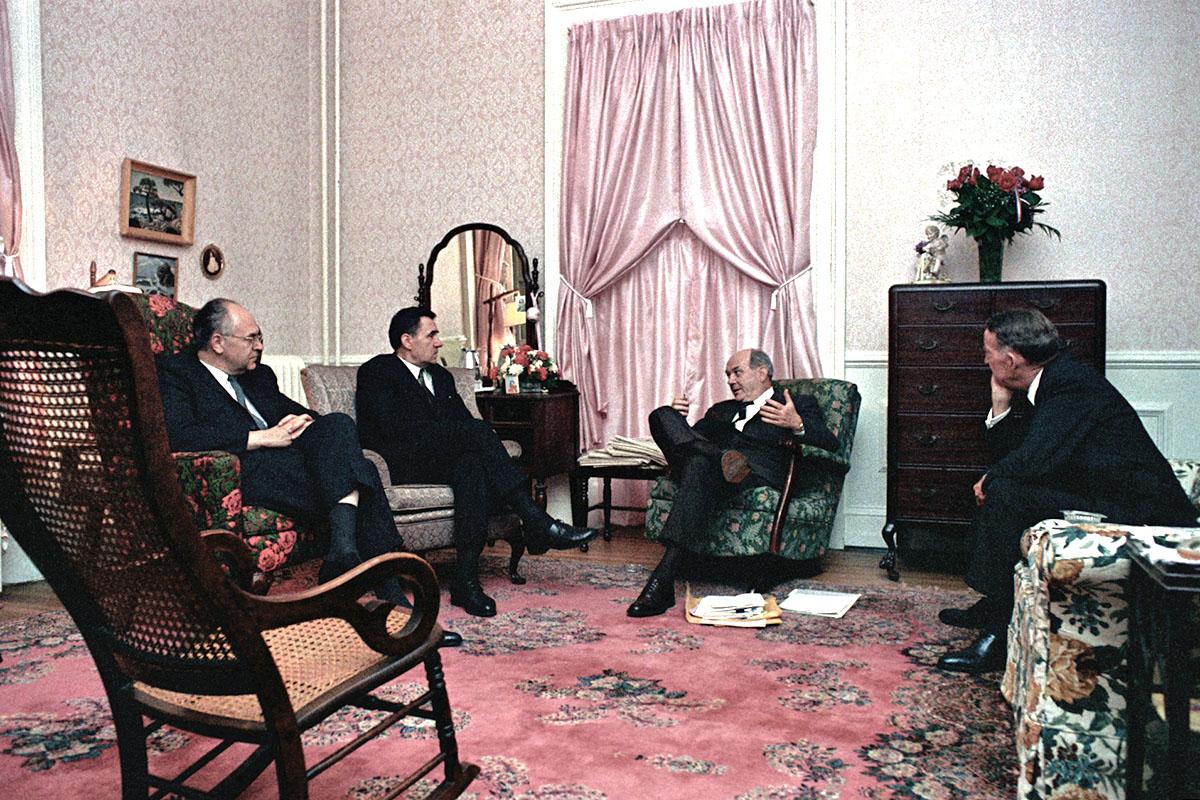 |
| Glassboro Summit, June 1967 (Dobrynin Gromyko, Rusk, Thompson) |
On September 15, the second tranche was published, detailing diplomatic negotiations over Moscow Signal 1967-77. There are several notable aspects to these papers. One continuous Soviet line was to lie that they were not beaming microwaves at the Embassy when in fact they were. They also claimed that the ambient microwave environment was well within Russian safety standards. This was accurate, for the most part, but failed to account for continuous exposure, and for the fact that occasionally Soviet safety standards were exceeded, with levels sometimes being measured at 13 microwatts per square centimeter (the Soviet limit was 10 microwatts, ours was 1,000). In addition, documents reveal there was an agreement in 1976 for Soviet and U.S. specialists to meet and discuss the microwave signals being beamed at the Embassy. The papers also show that press guidance started out as an effort to happy-talk the problem away, but gradually got more serious and detailed in response to AFSA criticism.
42. A Yahoo article by Michael Isikoff entitled "Top US Officials Cast Fresh Doubt on Sensational 'Havana Syndrome' Claims," dated September 14, 2022. It mischaracterizes the intelligence community's position, most likely not on purpose (see note 39).

42B. Conspiracyland: the Strange Story of Havana Syndrome, a five-part podcast released September 14-16, 2022 on Havana Syndrome, with two parts devoted to Moscow Signal.
43. A September 25, 2022 CNN special report on Havana Syndrome, hosted by Dr. Sanjay Gupta. One story focuses on a CIA doctor who suffered from Havana Syndrome. Here is the transcript of the special report. Moscow Microwaves are mentioned once.
44. On October 5, 2022 ADST published excerpts from Ambassador Hartman's Oral History. The Ambassador seemed to have a rather basic understanding of Soviet attempts to bug the New Office Building, but in one passage indicated that microwaves might have been involved: "One theory I’ve heard was the whole building was supposed to resonate from microwaves that were put on it and conversations could then be picked up." If what he heard was accurate, it would mean that the Russians were using, or preparing to use, microwaves against the US Embassy in the 1980s and after -- years after the period when most experts assumed that microwaving had stopped.
 |
| US Embassy Moscow 2000-Present (NOB and NEC 2003) photo: John Beyrle |
45. A CNN report, dated October 5, 2022, entitled "Dozens of CIA officers accuse intel agency of soft-pedaling its 'Havana Syndrome' investigation."
Quoting from the article: "As many as three dozen current and former CIA officers have gone to the House and Senate Intelligence Committees over the past year to raise concerns that a CIA task force has been soft-pedaling its investigation into a mysterious illness impacting agency officers and diplomats known colloquially as “Havana Syndrome,” sources tell CNN.

Carlson tells a story that parallels very closely the account in recently declassified documents, which revealed that Spaso residents were being bombarded not by microwaves, but ionizing radiation, and reported how Secret Service agents managed to stop the threat, at least for the duration of Nixon's visit. That Carlson was able to pick up this story and retell it in a humorous fashion indicates that it was generally known in Washington's national security community.

Episode 1. "Jericho." Deals with several Havana Syndrome incidents at the Embassy in Cuba. I am quoted briefly at 26:37 (no context).

 |
| Bill Burns |
51. ODNI issued an unclassified version of their Havana Syndrome assessment which is very useful. Updated Assessment of Anomalous Health Incidents, March 1, 2023.
My principal concern is that the conclusions of the new report are a bit deceptive. When talking about whether a foreign actor is involved in Havana Syndrome, the agencies concerned expressed a range of opinions from no opinion to very unlikely, with confidence ranging from high to low. If you do the math, based on the chart in the summary it would appear that the median conclusion among agencies would be that there is a one in four or one in five chance that some Anomalous Health Incidents were caused by foreign actors. It is not a blanket conclusion that foreign actors or weapons were not involved.
There are many other problems with the assessment, but three stand out: (1) ODNI says neither Russia nor China has directed energy weapons that might cause Havana Syndrome, and yet Putin himself has bragged about such weapons. (2) The Russians have a long history of directing microwaves at American officials (Moscow Signal), dating back to 1945, and are very advanced in this technology. (3) reports of new cases of Havana Syndrome stopped appearing right after CIA Director Bill Burns warned the Russians in November 2021 that there would be “serious consequences” if they were behind it. It was as if somebody had switched off a light. This seems a bit suspicious and needs to be explained.
55. A Hill article entitled "Rubio Rejects Intelligence Finding that 'Havana Syndrome' not Linked to Foreign Adversary", dated March 2, 2023.
56. A Washington Post article dated March 2, 2023, entitled "Is 'Havana Syndrome' Settled Now? The White House Won't Say."
My Comment: With regard to the March 1 ODNI assessment, it’s hard to tell without having full access to the classified report just what it really says, but the unclassified summary raises some questions.
My principal concern is that the reported conclusions of the new report are a bit deceptive. When talking about whether a foreign actor is involved in Havana Syndrome, the agencies concerned expressed a range of opinions from no opinion to very unlikely, with confidence ranging from high to low. If you do the math, based on the chart in the summary it would appear that the median conclusion among agencies would be that there is a one in four to one in five chance that some Anomalous Health Incidents were caused by foreign actors. I think the summary oversimplifies this into a blanket conclusion that foreign actors or weapons were not involved.
There are many other problems with the assessment, but three stand out: (1) ODNI says neither Russia nor China has directed energy weapons that might cause Havana Syndrome, and yet Putin himself has bragged about such weapons. (2) The Russians have a long history of directing microwaves at American officials (Moscow Signal), dating back to 1945, and are very advanced in this technology. (3) reports of new cases of Havana Syndrome stopped appearing right after CIA Director Bill Burns warned the Russians in November 2021 that there would be “serious consequences” if they were behind it. It was as if somebody had switched off a light. This seems a bit suspicious and needs to be explained.
I’m still agnostic about it. We’ve been working on this for over a year now, but the report itself does not look convincing to me, and I can see motivation where the Agency would be incentivized to say this. To me, this is not a closed chapter and we continue working on this.
What do you think those motivations could be?
Starting from the fact that no security and intelligence agency would want to admit that another security agency has outsmarted it and has unknown technology, ending with the fact that you don’t want to discourage new recruits or new applicants from joining your service by recognizing there’s such a threat.
Do you think the threat is actually real?
As I said, I’m agnostic, but it’s hard to discard something that has happened to so many people, to adults, children, and animals. Especially the latter two categories have a hard time faking it.
61. A Politico article dated March 10, 2023, entitled "The Time Russians Really Did Target Americans with Microwaves," by Casey Michel. "There’s a reason so many diplomats and CIA operatives think Havana Syndrome is real. It’s because it’s happened before — and the Kremlin got away with it." Features documents recently published by National Security Archives and an interview with James Schumaker (Embassy Moscow 1977-79).
62. A Politico article dated March 9, 2023, entitled "Pentagon is funding experiments on animals to recreate 'Havana Syndrome'", by Lara Seligman. "The Defense Department is funding experiments on animals to determine if radio frequency waves could be the source of the mysterious ailment referred to as “Havana Syndrome” that has afflicted hundreds of U.S. government personnel in recent years, according to public documents and three people familiar with the effort." Here is the DoD health site on Havana Syndrome.
63. A Guardian article, dated March 13, 2023, entitled "John Bolton Chose Not to Brief Trump on Havana Syndrome Suspicion."
"Donald Trump’s third national security adviser, John Bolton, did not brief the president on suspicions Russia might be behind mysterious “Havana syndrome” attacks on US diplomats because he did not think Trump would support him.
“Since our concern was that one of the perpetrators – maybe the perpetrator – was Russia,” Bolton said, “we didn’t feel we would get support from President Trump if we said, ‘We think the Russians are coming after American personnel.’”
"Bolton makes the startling admission in an interview for an episode of a podcast, The Sound: Mystery of Havana Syndrome, hosted by the former Guardian journalist Nicky Woolf and released on Monday."
Note: here is a link for part 8 of the podcast, the final episode of the series. The entire series is worth a listen.
64. Cipher Brief podcast dated March 10, 2023. Interview with Marc Polymeropoulos. "What I Know about Havana Syndrome." ODNI assessment uses questionable methodology. DoD has low confidence in the report. No peer review. Neither Marc nor others he knows were interviewed by the assessment team. Bill Burns deserves a lot of credit for accountability. He has no control over the assessment team analysts. Tells his story. Without getting into details, he knows many, many officers who were "tip of the spear" but are now incapacitated. Failure to find evidence does not mean nothing happened, especially in "denied areas." Institutional bias (recruiting, assignments) to make this go away. Antagonism between Agency Task Force and victims of Havana Syndrome. Agency initially treated victims very badly. Core group of two dozen unexplained TBI cases is unexplained. Agency did callout for any "headache" cases, so naturally got a lot of reports that were not Havana Syndrome. Thank goodness DOD and Walter Reed are not in agreement with ODNI. We will solve this mystery in the open source world. Bellingcat solved Skripal, could do the same with Havana Syndrome because they use more effective techniques. CIA is shutting down its investigative unit and investigation is transferred to DOD. Marc is getting compensation for life due to Havana Syndrome. Marc thinks the Russians are behind Havana Syndrome. Likely it's directed energy. Past Russian history of using directed energy. Also, some Russian intel travel patterns are suspicious. ODNI should have said no conclusive evidence yet, we should keep going -- not that there is no evidence so investigation is closed. What if we did solve Havana Syndrome? It would be an act of war, would have to be robust response. NSC is very good. CIA bad (with exception of Bill Burns, who tore down denialist CIA office of medical services). State was dismissive, now leading on compensation. DoD is continuing the investigation. Government dysfunction. Washington Post got the ODNI story first, were captured by denialist sources, wrote bad headline. Congressional oversight will review ODNI report. We may need a CI breakthrough, Russian intelligence defector, to get to the bottom of this mystery.
64A. An article in Politico from March 26, 2023 entitled "Pentagon still probing what caused ‘Havana Syndrome,’ even after spy agencies found no smoking gun." "The news that the Pentagon is continuing to study the issue comes after most intelligence agencies concluded in a comprehensive investigation led by the ODNI released Wednesday that it is “very unlikely” a foreign adversary using a weapon was responsible for the incidents. But the seven agencies that participated had varying levels of confidence in the final determination.
"Two of the agencies, which intelligence officials would not name [I'm guessing NSA and DIA], had low confidence in the assessment, because they still believe “radiofrequency (RF) energy is a plausible cause,” according to a statement from Director of National Intelligence Avril Haines.
"A wide body of research indicates a device that harnesses energy could be responsible for the Havana Syndrome incidents. A 2020 National Academies of Sciences, Engineering and Medicine report commissioned by the State Department to look into the initial cluster of incidents in Havana found that the symptoms were consistent with the effects of “directed, pulsed radio frequency (RF) energy.” A panel of outside experts also found that this was “the most plausible mechanism” to explain the illness."
65. An article in Gizmodo from March 28 entitled "Newly-Declassified Report Contradicts Officials, Suggests Havana Syndrome Might Be Caused by Directed Energy. A recently declassified version of an Intelligence Community report from September 2022 appears to contradict the conclusions of the "updated" unclassified version of the IC report published six months later in March 2023, and points to directed energy as the probable cause of Havana Syndrome. The March 2023 report is an update of an earlier report in January 2022, and appears to skip over the September 2022 classified report. It's all very confusing. This looks suspicious, to say the least.
66. An article in the Miami Herald from April 26, 2023 entitled "'Knife in the Back.' Havana Syndrome victims dispute report dismissing their cases."
This is a good article. It also has information that is new to me, noting that the March 2023 Intelligence Community's report on Havana Syndrome relied heavily on a November 7, 2021 JASON report that employed circular reasoning to deny that Havana Syndrome might be caused by directed energy attacks [see item 18a].
While couched in scientific terms, I believe that the conclusions of the report are overdrawn. Havana Syndrome victims have good reason to believe that the true causes of their condition are being papered over for geopolitical reasons, as well as concerns about being able to staff overseas posts, even though they are, at least, getting the treatment they need. A CIA doctor also notes that an additional possible reason the report seeks to minimize the serious political and medical issues raised by Havana Syndrome is the desire of certain agencies to dilute the results, "as they were involved in the premature decisions to ignore the medical complaints."
It should be noted that there was an earlier JASON report written in 2018 that concluded cricket sounds probably caused Havana Syndrome. That conclusion was, of course, ludicrous. [See item 15]
Quotes from the article:
“This is a very dangerous report that represents the worst type of science possible,” a scientist familiar with the Havana Syndrome cases told the Herald. He asked not to be named because he was not authorized to discuss the subject. “They were very indiscriminate in who they included as a possible victim. When you include individuals who may or may not have been affected, you don’t get an accurate view of those who were truly affected.”
"The scientist pointed out that the data was sometimes collected years after the person was affected. “The report sounds authoritative, which is unwise because the science is very suspect, if not totally wrong,” the scientist said. “And in some ways, it disenfranchises or discounts the truly affected individuals who are truly suffering. I think it was done entirely with political motivation.”
"The March intelligence assessment relies heavily on a 2021 report written by JASON [JFS note: see item 18a], a group of elite scientists that advises the U.S. government, to cast doubt on the original clinical findings by two independent teams of medical experts at the University of Miami and the University of Pennsylvania. Those teams were asked by the CIA and the U.S. State Department to test and treat American diplomats, CIA officials and family members stationed in Havana.
"The Miami team found that some victims had a unique pattern of balance and cognitive dysfunctions linked to abnormalities in the inner ear. The Pennsylvania team concluded that about two dozen Americans suffered from mild traumatic brain injury, similar to a concussion, even though none had suffered a blow to the head.
"In a later study in 2019, the UPenn doctors found the group had specific changes in their brains. Both teams strongly opposed theories that the injuries were psychosomatic, as an earlier FBI report and the Cuban government had suggested.
"Two other teams of experts — one from the U.S. National Academies of Sciences, Engineering and Medicine that published its findings in 2020, as well as a panel convened by the Office of the Director of National Intelligence and the CIA in 2021 to investigate potential causes — also agreed with the early medical findings that the symptoms associated with Havana Syndrome pointed towards a new medical disorder.
"But the authors of the March intelligence assessment paraphrased language from the JASON report to claim that while the initial studies concluded that the health incidents represented “a novel medical syndrome or consistent pattern of injuries similar to traumatic brain injury, a combination of medical and academic critiques pointed to methodological limitations in that work.”
"The CIA doctor who was affected in the Havana Capri Hotel incident said he believes that some of the participating intelligence agencies behind the March assessment “had an interest in diluting the results, as they were involved in the premature decisions to ignore the medical complaints. “The impact of the relentless impugning of the Havana group’s integrity and motivation has had serious impacts on their well-being,” he added, noting the group had passed extensive medical and psychological tests."
67. Foreign Service Journal, May 2023, page 16. "Havana Syndrome Cause Remains a Mystery." Reports on controversial March 1, 2023 IC report on Havana Syndrome [see note 51], Politico interview of James Schumaker on Moscow Microwaves and Havana Syndrome [see note 61], and Guardian Journalist Nicky Woolf podcast on Havana Syndrome, including interviews with Schumaker and retired CIA Officer Mark Polymeropoulos in part 6 [A Silent Injury] [see note 48].
68. The Intelligencer, Journal of the Association of Former Intelligence Officers, Vol. 28, Winter-Spring 2023, "The Mysteries and Realities of the Havana Syndrome: It's the Russians," by Lewis Regenstein. The most complete summary of Moscow Microwave/Havana Syndrome cases in print, beginning with Moscow Microwaves in 1953 and continuing through suspicious incidents after the fall of the Soviet Union, and then the outbreak of Havana Syndrome cases in 2016 until the present day. Available for members only.

69. A May 19, 2023 story published in "The War Zone," entitled "THOR Microwave Anti-Drone System Downs Swarms in Test." "It's also worth noting that while countering drones [is] the main objective at this time, HPM systems can also potentially be used against low-flying cruise missiles and even land/surface targets. (see item 3A)"
70. As an experiment, I asked ChatGPT to write a short history of the relationship between Moscow Signal and Havana Syndrome. For many, ChatGPT is considered scarcely better than a magic eight ball, while others darkly fear it is the next SkyNet. In fact, the short history ChatGPT delivered was pretty good -- if bland.
The complete annotated document is available on New Bing at https://sl.bing.net/igQE43BuKYK
Here is ChatGPT's answer:
Here is a short history of the relationship between Moscow
Signal and Havana Syndrome:
- The US government **concealed** the existence of the beam
from the public and most of the embassy staff for a decade, until it was
exposed by a journalist in 1976¹²⁵. Some embassy employees reported **health
problems** such as headaches, fatigue, irritability, and memory loss, which
they attributed to the microwave exposure¹²⁵.
- The US government conducted a **medical study** of the
embassy staff, known as **Project Pandora**, which found no conclusive evidence
of adverse health effects from the beam, but also acknowledged that there were
**uncertainties** and **gaps** in the scientific knowledge of microwave effects
on humans¹²⁵. The US government also negotiated with the Soviet government to
**lower** the intensity of the beam, which eventually stopped in 1976¹²⁵.
- The **Havana Syndrome** is the name given to a mysterious
illness that has affected more than 200 US government employees and their
families at overseas embassies, especially in Havana, Cuba, since 2016²³. The
symptoms include **cognitive and neurological impairments**, such as migraines,
dizziness, memory loss, brain fog, and hearing loss, often accompanied by a
**peculiar sound** or a sensation of heat or pressure²³.
- The cause of the Havana Syndrome is still **unknown**, but
some experts have suggested that it could be a result of a **directed energy
attack** using microwaves or other forms of electromagnetic radiation²³. Some
have also drawn parallels with the Moscow Signal as a possible historical
precedent or inspiration for such an attack¹²³.
- The US government has been investigating the Havana
Syndrome with various agencies and committees, but has not reached a definitive
conclusion or identified a responsible party²³. The US government has also
passed legislation to provide **medical and financial support** to the victims
of the Havana Syndrome, and to enhance the **security and protection** of US
personnel abroad²³.
I hope this helps.😊
Source: Conversation with Bing, 5/30/2023
(1) The Moscow Signals Declassified - National Security
Archive. https://nsarchive.gwu.edu/briefing-book/intelligence-russia-programs/2022-09-15/moscow-signals-declassified-microwave.
(2) Before Havana Syndrome, There Was Moscow Signal. https://afsa.org/havana-syndrome-there-was-moscow-signal.
********************************
And, because I know you want to ask it, here is ChatGPT's answer to the question: "Are the Russians Responsible for Havana Syndrome?" (complete answer available at https://sl.bing.net/fBfBVpjaRAy )
Havana Syndrome is a cluster of idiopathic symptoms experienced mostly abroad by U.S. government officials and military personnel. The symptoms range in severity from pain and ringing in the ears to cognitive dysfunction and were first reported in 2016 by U.S. and Canadian embassy staff in Havana, Cuba1. Since then, more cases have been reported in other countries, such as China, India, Vietnam, Austria and the U.S.123.
71. A June 13, 2023 article published in Popular Mechanics entitled, "What is Havana Syndrome and Could It Really Have Sickened U.S. Diplomats?" Also notes the Frey effect and Soviet use of microwaves against US Embassy Moscow.
It would seem that Popular Mechanics isn't exactly buying the story put out by intelligence community analysts on Havana Syndrome.
Lots of people aren't.
"The Soviet Union was known to have conducted experiments in using RF energy as a weapon, both as strategic weapons and against diplomatic personnel assigned to the U.S. embassy in Moscow in the 1970s. Individuals assigned to the agency did not report any immediate health effects but many, according to NPR, came down with serious health issues years later.

"The Takeaway
"Reports of Havana syndrome slowed as it gained publicity, with the latest reported incidents happening in Geneva and Paris in 2021. Is Havana syndrome an attack created by a man-made device, a natural phenomenon, or a case of mass hysteria? If it is an attack, we have a possible explanation for how the machine works, a precedent, and a political motive.
"Whatever is going on, it is complex enough that U.S. intelligence agencies are unable to determine the cause—even as it happens to their own people."
72. The Courthouse News Service reported on June 28, 2023, that: "A federal court in Maryland granted the National Security Agency’s motion for summary judgment on a Freedom of Information Act lawsuit brought by a former federal agent who developed a rare form of Parkinson’s disease 10 years after he traveled to “a hostile foreign country” in 1996. The NSA denies having evidence that he was exposed to some wave-based weapon that could’ve damaged his nervous system, and has properly classified the requested information on national security grounds."
The court appears to have disregarded NSA's 2014 admission that the "hostile country" had a microwave weapon that might affect a person's health. The decision seems to give weight only to the fact that there is no evidence the "hostile country" used such a weapon on Mr. Beck. I'll be interested to see the legal fallout from this.
Here is the FOIA Case Detail: https://foiaproject.org/case_detail/?title=on&style=foia&case_id=34347
73. A July 6, 2023 Washington Times article entitled "China's Military is Leading the World in Brain 'Neurostrike' Weapons", by Bill Gertz. According to the report that is summarized in the article, China is developing a microwave-powered neuroweapon that creates effects very similar to Havana Syndrome. Gertz has a track record of alarmist reporting, but while his conclusions are often exaggerated and ideologically tinged, they are usually based on a foundation of fact, in this case, a report, which on first reading appears speculative.
74. An August 8, 2023 Explainer by First Post entitled "Centre to Investigate Havana Syndrome: What's the Mysterious Illness Plaguing U.S. Officials Since 2016?" focusing on the September 2021 case of a CIA officer traveling with Director Burns in India.
75. An August 10, 2023, obituary entitled "Paul Brodeur, Journalist Who Exposed Asbestos Hazards, Dies at 92." In December 1976, Brodeur published a pair of articles in the New Yorker on the dangers of microwaves that included a long discussion of U.S. and Russian military research into microwaves and also Moscow Signal. The complete New Yorker article is available in this obituary. The Moscow Signal portion begins on page 90. Neither the obituary nor the Brodeur article are behind a paywall.

76. A WNYC podcast, “The
Mystery of Havana Syndrome,” broadcast on August 25, 2023. Dr. Robert
Bartholomew, the author of a book
denying that Havana Syndrome is anything more than a psychogenic illness (his
specialty), is interviewed. Bartholomew, however, has consistently disregarded
all evidence indicating other possible explanations, and has never examined any
Havana Syndrome patients. His views are therefore not credible.
77. An October 8, 2023 article in Microwave News, entitled "Paul Brodeur, the Initial Microwave Pioneer: Setting the Record Straight." Makes a persuasive case that the dangers of microwaves, particularly with regard to leukemia, continue to be disregarded and covered up by various governmental and business entities.


Here is part two, released on April 3, 2024. Here is the transcript. Features Marc Polymeropoulos. 45 minutes in length. Strong circumstantial evidence that American personnel have been the victims of a Russian attack. Why is the USG not acknowledging this? Faye Flam Bloomberg Science columnist (not well informed on latest developments): Havana Syndrome is real, but probably has large psychosomatic component. Jerry O'Shea: We already know the Russians have bathed our Embassy in Microwaves. Until Bill Burns, CIA resisted dealing with reports of Havana Syndrome. CIA then sent out worldwide query, got 1500+ possible cases, winnowed down to a couple of dozen who all were in CIA, had similar symptoms, worked in Russian specialty areas. JASON Group skeptical that microwaves could cause Havana Syndrome, but did not have all information and no access to victims. In the past, JASON group has been skeptical about similar Russian capabilities and been proven wrong. Attacks may not be directed at people, but devices. Frey effect discussed. Next Guest: Marc Polymeropoulos. Details his experiences (see Insider article). Trashes the "mass hysteria" theory. Says previous administration (Trump) messed up on Havana Syndrome and also on the bounties in Afghanistan issue (in latter case, intelligence is conclusive that Russians were guilty). Russians have never been held accountable. White House didn't want to hear anything about Russians targeting Americans. Doesn't get into specifics or IG report, but says he has briefed Congressional committees, obvious he thinks CIA handled Havana Syndrome very badly, and his case is just one of many. In his case, CIA was so obstructionist he finally had to go public with an article by Julia Ioffe. Very embarrassing to the Agency. CIA also screwed up by sending out worldwide inquiry on Havana Syndrome symptoms. Just caused people to report in who didn't have the Syndrome and obscured the few dozen who did. Many colleagues and one junior doctor stood by Marc, but Senior doctors and officials behaved very badly, just got in the way. Jake Sullivan and Bill Burns met with CIA doctors, told them their obstructionism was very detrimental to Marc's care. Marc knows many colleagues who have suffered worse than he has. CIA as an institution didn't want to acknowledge or deal with the problem under Trump. If Havana Syndrome is due to a hostile foreign actor, it's an act of war. There are a couple of dozen cases that are TBI's without prior medical history, cannot be explained satisfactorily. Several dozen are getting compensation from Havana Act, although it isn't enough. In light of recent revelations about Havana Syndrome, "everything's shifted wildly." CIA still briefing that everyone had pre-existing conditions and that Marc and others' cases are not real even though they are getting compensation. "It's bullshit." Moderator notes that CIA has been burned several times by jumping to conclusions (WMD, Iraq War), and so now are gun-shy. This case is even worse, because they know if they make an analytic judgment, the administration will be forced to act. Marc says he believes Russians may have been using some device for espionage purposes, realized it also hurt people, and then started using it for that purpose. Moderator notes that Donald Trump's attitude toward Vladimir Putin may have also affected CIA's willingness to draw conclusions. Marc agrees, but says that under Trump the holdup was more a matter of gross incompetence. Under Biden, the analysts are freer to do assessments, and Biden takes the matter seriously. Moderator: Havana Syndrome is not a conspiracy theory, it is a mystery for which we do not yet have all the answers. Who is going to accept an assignment to Moscow, not knowing the answers to the questions posed by Havana Syndrome? Perhaps it is just too dangerous. For whoever is doing this, maybe creating chaos and a feeling of danger is the objective. Coupled with this is a feeling that there are no longer any rules. CIA never uses journalist for cover, for example, and both sides know this, and yet Russia is treating journalists very differently now than they did before, as if they were all spies without immunity. Bottom line: it's "credible to likely" that the Russians are up to something, but we won't know for sure until "one fine day" we get the right defector. "Absence of evidence is not evidence of absence." Just because we can't pin Havana Syndrome for sure on one actor doesn't mean that no one is guilty. The most likely conclusion is that some people (like Marc) were the victims of a hostile attack. We know for sure the Russians are already involved in assassinations and sabotage. It is likely that they are also causing Havana Syndrome. Vladimir Putin has changed the rules of the game.

"A yearlong investigation by The Insider, in collaboration with 60 Minutes and Der Spiegel, has uncovered evidence suggesting that unexplained anomalous health incidents, also known as Havana Syndrome, may have their origin in the use of directed energy weapons wielded by members of Russian GRU Unit 29155. Members of the Kremlin’s infamous military intelligence sabotage squad have been placed at the scene of suspected attacks on overseas U.S. government personnel and their family members, leading victims to question what Washington knows about the origins of Havana Syndrome, and what an appropriate Western response might entail." https://theins.press/en/politics/270425

90. A CBS Sixty Minutes segment entitled "Targeting Americans," dated March 31, 2024, updates the segment from two years ago (see notes 33, 86, and 88). Too many startling revelations to summarize. Take a look at the videos and the referenced notes.


"According to Grozev, a document within the email shows that Russian intelligence lobbied for and received permission from President Vladimir Putin to provide exclusive technology to Vietnamese security services. Among the list of recommended technologies to be shared were "LRAD acoustic emitters" and "short-wave equipment for scanning the human body.
"LRAD, which stands for "long-range acoustic device," is a military-grade sonic weapon that discharges a targeted beam of sound at extremely high volume. An LRAD device was used to thwart a pirate attack on a cruise ship in 2005, and since then, the U.S. military has used the devices to send warnings in the field, such as cautioning people away from an Army base perimeter. But when left on at its highest volume, some LRAD systems can produce a sound pressure level of 162 decibels. The human pain threshold is about 130 decibelBased on his research, Grozev said he suspects Russia is sending weapons technology like this, which may be used in Havana Syndrome attacks, to foreign governments.
"I believe that Russia is assisting other governments with some operations that those governments may want to do on their own, and in this way establishing loyalty from these governments for future operations that Russia might need on their territory," Grozev told 60 Minutes.
"Retired Army Lieutenant Colonel Greg Edgreen ran an investigation for the Defense Intelligence Agency into anomalous health incidents, which have been referred to as Havana Syndrome attacks because they were first reported by American officials based in the U.S. embassy in Cuba in 2016. He told 60 Minutes he also believes Russians were involved in the 2021 attack in Vietnam.
"They saw us getting closer and closer to Cuba, and they wanted to stop it…" Edgreen said. "Then they tried to follow up and do the same thing with Vietnam, another long-term strategic ally to Hanoi, by disrupting Vice President Kamala Harris' trip to Vietnam."
"While running the military investigation into anomalous health incidents, Edgreen said the Pentagon supported his investigation into whether Russia was behind the attacks. But the Trump and Biden administrations set the bar for proof impossibly high, he said.
"Grozev believes the U.S. government would require a very high threshold of certainty before they could acknowledge the Kremlin's role — because of what will happen if they do.
"Once you admit that this happened, it is a Pandora['s] box," Grozev said. "It requires you to confront the fact that you have your arch enemy acting against your own people, your own intelligence workers, on your territory, and this is nothing other than a declaration of war."
92. A March 31, 2024 article in The Insider entitled, “All I wanted was to see a doctor”: Ex-CIA officer tells all about his battle with Havana Syndrome — and his former agency, by Mark Polymeropoulos.

93. A March 31, 2024 article in Axios entitled, "Russian assassination unit linked to U.S. officials' "Havana syndrome." A good short summary of the CBS-Insider-Der Spiegel investigation.
94. An April 1, 2024 article in Foreign Policy Research Institute entitled, "Havana Syndrome: The History Behind the Mystery," by Lewis Regenstein. Contains useful information on the possible connections between Moscow Microwaves and Havana Syndrome, among other things. Also, see note 68.
95. An April 1, 2024 article in The Guardian entitled, "‘Havana syndrome’ linked to Russian unit, media investigation suggests," providing a summary of the CBS-Insider-Der Spiegel report that GRU unit 29155 is likely behind Havana Syndrome, with Kremlin press spokesman Peskov's reaction. Since Peskov almost always lies, he is a reliable predictor of what is actually true.
96. April 1, 2024. The State Department press spokesman Matthew Miller has said, in answer to questions, that State personnel will not face any penalties for disagreeing with the position of the Department and the intelligence community on Havana Syndrome, but that the Department's position on the issue remains the same.

Of course, everyone is grateful that no one will be punished for saying that the Emperor has no clothes, but it is past time for the Department and the community as a whole to bring their position into conformity with the obvious truth: the Russians, specifically the GRU, are attacking US diplomats and other government personnel with microwave weaponry that causes Havana Syndrome. To repeat, they are attacking our personnel. Any position short of this does a disservice to those loyal employees who have suffered as a result of Russian attacks and does a disservice to the American people as a whole. It's time to face facts, draw the appropriate conclusions, and take action.

Signed Acoustic Weapon Contract (2017)
Sharon Weinberger has written a well-reasoned piece on the problems involved in tracking down the causes of Havana Syndrome, and in particular the problems with designing a microwave weapon that would be portable and effective.
The problem is that her information is at least two years out of date, and possibly more. As Christo Grozev showed in his "The Insider" article from March 31, GRU Unit 29155 has been linked through documentation to just such weapons. The documents are available in the Grozev article. We may not know how to make them, but the Russians, who have led us in microwave research since Moscow Signal days, definitely do.
In addition, there are older articles, now blocked by the Russian Ministry of Defense, that claim that the Russians have portable devices that can cause symptoms similar to Havana Syndrome. For example, in 2019, Армейский Сборник published an article entitled В ПОИСКАХ «ГУМАННОГО» ОРУЖИЯ (in search of humane weapons) that copped to the entire program. I have the article on my website if she is interested. She won't find it anywhere else.
In addition, Ms. Weinberger would do well to check out the interview with Marc Polymeropoulos, a victim of Havana Syndrome, in "Mission Implausible" Havana Syndrome, part 2, of April 3, 2024. He and his former CIA colleagues have a few things to say about Havana Syndrome and the obstructionism of the Trump administration that might interest her.
103. An April 6, 2024 podcast, "Foreign Office with Michael Weiss," entitled Compelling Investigation Suggests Havana Syndrome Points to Russian Operatives." Goes into the detailed detective work tracing GRU Unit 29155 and how they always seemed to be present at Havana Syndrome attacks. Lots of names, dates, places, and documents were unearthed, most of which are already possessed by the U.S. intelligence community. Too many coincidences to be just chance occurrences. Here is the transcript.

Investigative journalists Christo Grozev, Roman Dobrokhotov and Michael Weiss have been looking into the Havana Syndrome since 2020. They initially approached the topic skeptically, questioning the capability of any government to carry out such a mass global attack. However, they discovered a document linking a Russian military unit to the Havana weapon, which sparked their investigation. They have been gathering evidence of overlaps between the travel of members of this unit and incidents related to the Havana Syndrome. The journalists have presented a prosecution case, highlighting motive, means, and opportunity, and are calling for the U.S. government to act as a defense attorney for the accused criminals.
Christo Grozev/Michael Weiss: [Weiss]Many Havana Syndrome victims suffer from Meniere's Disease. A GRU Institute specializes in this disease. Documentary proof that Andrey Averyanov is in contact with this GRU Institute constantly. [Grozev] Putin has highlighted the need for new weapons using new principles that will not kill, but just disable and be harder to detect. Patrushev has boasted that over the last ten years, Russia has "disabled" hundreds of Western agents [note: I believe Patrushev said "neutralized"]. Documentary proof that at least one type of "acoustic" weapon works (photo of an award for the invention). Evidence that teams being sent out by GRU now have doctors for support, in case the weaponry they are using to assassinate or disable blows back on them (Novichok, kinetic weaponry such as acoustic weapons). So, motive, means and opportunity are proven. We have proven six instances in which GRU teams were present in the same place as Havana Syndrome attacks. USG needs to come forward and explain why this evidence is not valid -- if they can. Instead, USG just gives blanket denials with no evidence. [Weiss] DIA (Edgreene) does not agree with the ODNI assessment and thinks it's the Russians. Clear that a deeply politicized debate is raging inside the intelligence community. Roman Dobrokhotov: The Russian version of the Insider story took off like wildfire on the Internet. Russians and Westerners on the Internet think that some kind of new red line has been crossed when a dictator (Putin) goes after his enemies in this way who are also diplomats or agents of a superpower. Almost a casus belli. Zakharova and Peskov are reacting uncharacteristically to these reports, in recognition that the implications are much more serious. It is a violation of the so-called "Moscow Rules" that you don't attack such people on each others' grounds (Russians don't attack American officials in America/friendly countries, and vice versa). We have proven that Havana Syndrome cannot be explained as psychosomatic. Our investigation shows that there is "more than enough proof" that the Russians are doing this. Also, the physics has been proven. Frey effect occurs when microwaves cause acoustic effects within the brain. American officials are silent because they understand the implications if they confirm what we already know. Michael Weiss: Thousands of people came forward to say they might have Havana Syndrome. There are a lot of false positives because the CIA sent out a worldwide plea for people to report symptoms they thought might be Havana Syndrome. The victims we interviewed, however, did not know of other people experiencing symptoms, and other diseases and psychosomatic factors were ruled out. Was originally called "Havana Syndrome" because the first cases were identified there in 2016-17, and some thought an attempt was being made to disrupt US-Cuban relations, which began improving under Obama. But we have identified at least one case in 2014 in Frankfurt with a GRU presence (Igor Gordiyenko), so it's not just about Havana. The victims that stand out the most have been "Russia Hands," including almost the entire Kyiv Station (or family), whose members inaugurated intelligence sharing with HUR in 2015. Q: Why is the US doing nothing? Q: What do you do against Russia, who is threatening to use nuclear weapons against the West regularly, and, if you acknowledge what is happening, how do you recruit people to serve as Russia Hands? Grozev: GRU 29155 was for years not concerned with targeting Americans, but instead regime opponents. Why the change? And if there is no retaliation, what is to stop the Russians from continuing? If the US invested a lot of effort into hunting members of GRU 29155, it would not be that hard to get results. We already have a list of several dozen potential arrestees, and we do not have the resources of the US. Trials on American soil would be a good deterrent to future GRU action. Putin is pragmatic. He will not stop unless he knows there are consequences. Weiss: Canadians have also been targeted. Another question that needs to be answered is why are no other nationalities (UK, France, Germany) being targeted? Oleg Kalugin told Weiss that the rule was that Russia would not go against the main adversary (the US). That Moscow rule now no longer holds.
104. An April 5, 2024 podcast on SpyTalk, featuring Michael Isikoff raising questions about the CBS Sixty Minutes report on Havana Syndrome [See note 90], entitled "More Havana Syndrome Questions." Moderator is Jeff Stein. Isikoff tries to poke holes in the story, but comes across as gullible when it comes to believing the official line from CIA, and ignorant about basic facts.

Isikoff: Nobody disputes that hundreds of US personnel suffered debilitating symptoms. But CIA's Global Health Cell concluded that it is very unlikely that a foreign adversary is behind any of these attacks. Isikoff was briefed on their efforts two years ago and they were very thorough. They couldn't find any evidence of a foreign adversary. [Note: they allegedly couldn't, but The Insider did: see notes 86-103]. Isikoff's first objection: 60 minutes didn't say anything about this CIA Report until 2/3 through their story [Note: But The Insider takes this on directly and convincingly -- see notes 86-103]. Isikoff's second objection: Where's the weapon and what does it look like? How big is it? What's the power source? Nobody knows [Once again, these questions are addressed in the Insider Article (note 88)]. Moderator says he has tracked down DoD patents for these weapons, but it's classified research. Isikoff's third objection: 60 Minutes report refers to brain injuries, but NIH study says there were none. [This study has been debunked, see notes 81, 82, 84, 85]. Moderator quotes Dr. James Giordano of Georgetown who says that microwaves can cause the equivalent of "the bends" without leaving a trace. Isikoff's fourth objection: Not true that all victims are Russia hands. Isikoff interviewed woman in Havana who had nothing to do with Russia, was HR officer. Also, wife of "Justice attache" in Georgia was a victim. Comment: I'm amazed at Isikoff's naivete. Is the HR person married? Where did the attack take place? (rhetorical questions indicating that we need to know more about her relationships and location during the attack). On Georgia, who is the FBI looking at in Georgia as likely counterintelligence targets? Where did the attack take place? Also, "The Insider" authors are not saying that it's exclusively Russia Hands -- they are just the ones that stand out. This implies that the others might be mistaken attacks. There is a likely Russia connection, even if he can't see it. Isikoff's fifth objection: The Russians, if they had such a weapon, would use it in Ukraine on our people there, and on Ukrainians. Here Isikoff is flat wrong, and his demonstrated ignorance is appalling (see note 103). In fact, members of the 2015 Kyiv station were attacked, only it was after they left Ukraine for other posts. Also, as explained in note 103, the Russians are using the weapon causing Havana Syndrome almost exclusively against Americans (in the hope of breaking Moscow rules without detection) and have other ways to get at Ukrainians -- notably poison and straight-up assassination. The reason: they have no need to conceal their attempts to kill Ukrainians. They also have reason not to kill American officials, but to disable them in undetectable ways. Isikoff also scoffs at Olivia Troye's story but gets the office geography of the EOB and White House wrong, so it's clear he doesn't know what he's talking about. Moderator brings up fact that Russia, China, and the US are all researching microwave weapons and that Russia for decades bathed our Embassy in Moscow in microwaves. This is true. Isikoff makes the point that the most anti-Cuban Senators, Rubio and Menendez, wanted to blame Havana Syndrome on Cuba in order to downgrade relations. This is also true.
105. April 9, 2024. AFSA Calls for Further Investigation into Cause of Anomalous Health Incidents (AHIs) afsa.org


"At this time, we recognize that we must not let allegations carry more weight than evidence," the members of Congress wrote. "However, the 60 Minutes piece presented compelling evidence that warrants further review."
"The letter was signed by, among others, Sen. Susan Collins (R-ME), a senior member of the U.S. Senate Intelligence Committee, Sen. Jeanne Shaheen (D-NH), a senior member of the U.S. Foreign Relations and Armed Services Committees, and Sen. Mark Warner (D-VA), chairman of the Select Committee on Intelligence.
"There is no higher priority than the health and safety of American government employees and family members who commit their lives to advance U.S. national security interests," they wrote. "We must do everything we can to protect them."
------------------------------------------------------------------------------------
“The opinions and characterizations in this piece are those of the author and do not necessarily represent those of the U.S. government.”
Cleared for publication
by the U.S. Government
To go back to Chapter 11.5 Moscow 1977-1979, use this link